

Heroin addiction cost Sarah Hiscox her marriage and the chance to be with her children. She hasn’t used drugs in nearly 25 years, but she still struggles with low self-esteem and a constant feeling of being “not good enough.” These very thoughts were once a reason for her addiction, and today they could push her back to drugs. Sarah shares how she learned to cope with self-hatred and why, even after decades of sobriety, the work on oneself never ends.
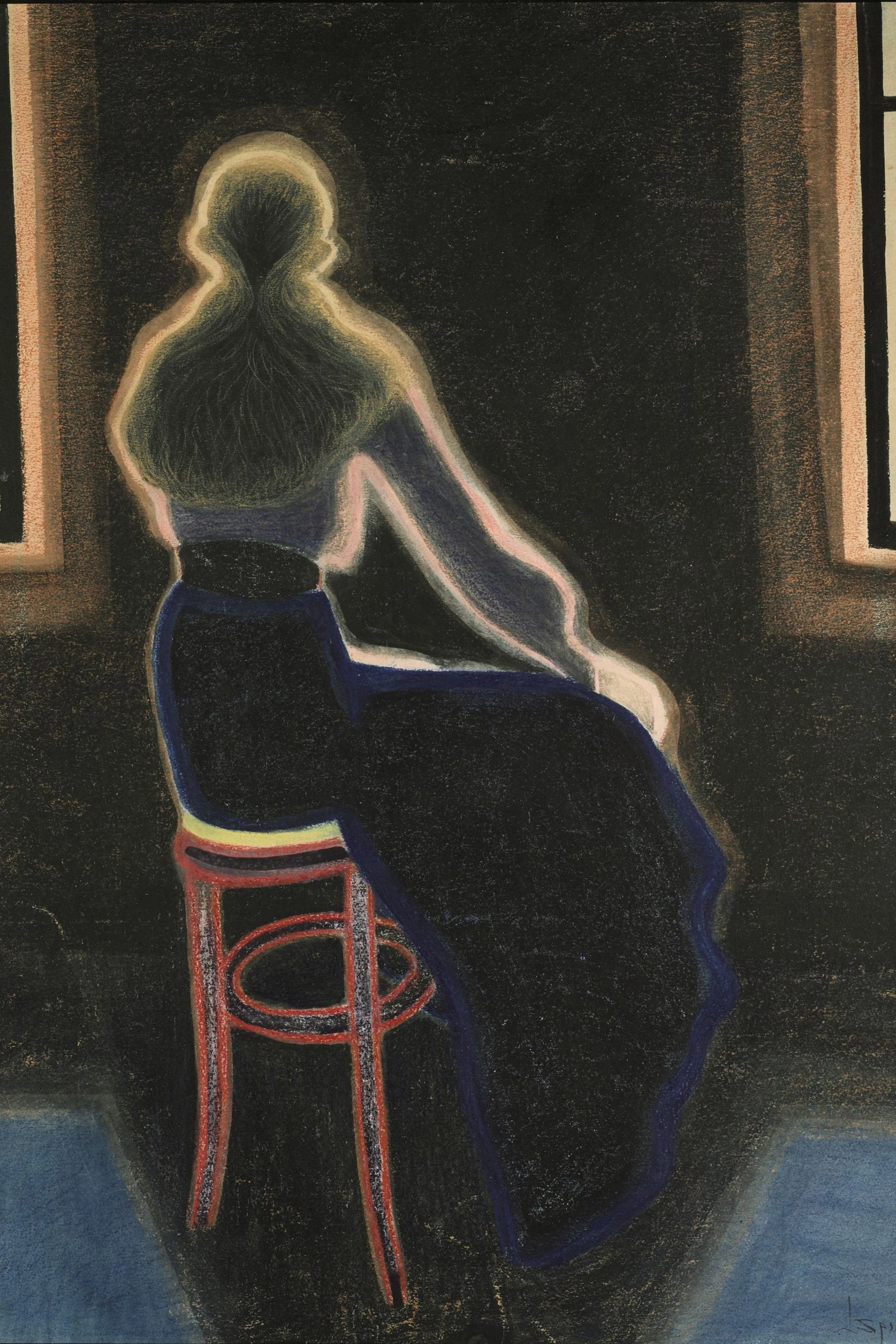 “Young Woman on a Stool”, Leon Spilliaert, 1909
Advertisement.
I am in recovery from addiction and have been clean from drugs and alcohol for almost 25 years. But a few months ago, I found myself sitting at my kitchen table again with a schedule of “Narcotics Anonymous” meetings in front of me. I hadn’t attended meetings for a year and a half. I thought I didn’t need them anymore. I had spent the last two years writing my book, The Beginning and End of Everything, and I believed that was enough to make me feel good.
Then, a series of events threw me off balance. My book was about to be released, bringing with it public attention that I found myself unprepared for. Some things didn’t unfold as I had expected. And very quickly, I found myself back in the same state I was in before writing the book. The familiar feeling of not being good enough washed over me again. It became so intense that I could barely get off the sofa. I felt exhausted, my body felt heavy, and I had no energy for anything. The same thoughts echoed in my head: “You’re not a real writer. No one will take you seriously. Why did you even start all this?” I honestly thought I would never feel this way again. I had been treating myself much better for the past few years. I had written a book, and it was going to be published. That’s a dream, right?
I could finally tell myself that I had accomplished something significant. That I had achieved something. That I had succeeded. It felt like I finally had proof that I was worthy of something, and this feeling of inadequacy would never return. But I was mistaken. I tried to boost my self-esteem through external success, when in reality, I needed something entirely different. I was once again seeking a way to fill an inner void in the wrong place.
Before I stopped using drugs, the feeling that something was wrong with me defined almost my entire life. I wasn’t smart enough, beautiful enough, interesting enough, thin enough. Ultimately, these thoughts destroyed my life. First, I invented stories about myself. Then, I started taking sleeping pills. Eventually, I developed an eating disorder. And then came the drug addiction, which gradually consumed my entire life.
When I was eight years old, I told everyone at school that my father was the famous Swedish tennis player Björn Borg. During breaks, I would recount in great detail how we spent weekends at tournaments all over the world and dined with celebrities. I even wore sweatbands on my wrists. Unfortunately, the school didn’t allow me to wear a headband.
Of course, all of this was a fabrication. I don’t think I knew how to play tennis at all when I was eight. And it wasn’t just about wanting attention. In truth, I wanted to be someone else. I felt that without this absurd story, no one would want to be my friend or accept me as I was. I didn’t believe I could be liked just for being me. I felt like I wasn’t enough on my own.
A few years later, I began constantly monitoring what and how much I ate. By the end of my teenage years, I had severe bulimia. I would binge eat and then try to purge the food. For a brief moment, it helped to numb the inner emptiness and brought relief. But very quickly, it was replaced by even stronger self-hatred. I was ashamed of what I was doing, and this shame only grew. That’s why I remained silent and never told anyone about my problem.
The transition to heroin felt like an almost natural progression of this path. It not only suppressed my appetite but also gave me exactly the feeling I had been searching for so long. Suddenly, it felt like everything was okay with me. That I had finally become a whole person. After so many years of searching, it felt like a miracle. But it wasn’t a miracle, of course. Very quickly, the heroin addiction spiraled completely out of control. After rehabilitation and endless therapy sessions, my husband divorced me and took the children. Even now, as I write this after 24 years of sobriety, it’s hard for me to believe it all went so far. How could I have let that happen? How could I have lost what I loved most in the world?
Addiction is a terrible thing. And many people cannot overcome it. I understood that I was lucky in a sense. I came from a well-off middle-class family and had financial support that many other people with addiction lacked. I didn’t have to steal to buy drugs. I didn’t have to sell my body, as many other women with addiction have to. But money and a seemingly normal life from the outside didn’t save me. I might not have fit the common stereotype of a heroin addict. But it doesn’t matter how much money a person has or their social standing. Many people with addiction share the same deep-seated feeling of worthlessness.
I felt like heroin had complete control over me. Every morning I would wake up and swear to myself that today I definitely wouldn’t use. But then I would remember all the damage I had done, and guilt and shame would overwhelm me. I couldn’t cope with it. At some point, I would just think, “Screw it all,” and use again. Heroin didn’t bring me joy. I didn’t use it for some incredible high that I wanted to experience repeatedly. I simply couldn’t imagine living without it. I thought about suicide, but I couldn’t bring myself to do it. So, sometimes I just hoped the drugs would kill me on their own. And preferably as quickly as possible. It never even occurred to me that one day I could actually live without drugs.
I tried to quit countless times. But I kept trying anyway. From time to time, a small flicker of hope would emerge that this time it might work. And I held onto it with all my might. I always imagined addiction as a carousel. Although it would be more accurate to call it a carousel of suffering. You go around and around. And every now and then, you see an “Exit” sign in front of you. You never know when it will appear next. So, when you see an opportunity to get off, you have to take it. Because who knows when the next one will come.
One day, I finally seized such a chance and believed I could manage. One day without drugs became two, and then those two days turned into 24 years of sobriety. As they say, one day at a time. My ex-husband and I got back together. We remarried for the second time almost 20 years ago. We had another daughter, Lucy. Her arrival helped heal much of the pain and gradually restore what had been destroyed. I received more than I could have ever hoped for. And from time to time, I need to remind myself of this. Especially when that same emptiness reappears inside me.
Recently, a friend asked me about my addiction and what it means to me. “It’s very simple,” I said. “Deep down, I’ve always been convinced that I’m not good enough. But now I know how to live with it. I’ve learned not to let those thoughts destroy me and the people around me.” “And who told you that you’re not good enough?” she asked. I shrugged: “Probably me. But now I know how to deal with it.” She looked at me as if she didn’t understand why I was so sure. “What if it’s not true? What if you’re actually good enough, and you’ve just been convincing yourself otherwise all these years?” she said. I stood there and looked at her in silence.
Perhaps I had heard something similar a thousand times in my life. But at that very moment, those words suddenly truly reached me. What if she’s right? What if everything is actually okay with me, and I’ve just been repeating a falsehood to myself all these years? Why can’t that be true? What would change in my life if I started thinking differently about myself? That I’m no better or worse than anyone else? That I’m just like everyone else. That I don’t need to prove anything to have value. That I am already good enough.
I could have continued to hate myself because that feeling had long become a habit for me. Sometimes it’s truly easier to stay in it than to try to change something. But I don’t want to live like that anymore. I want to get rid of this self-hatred because I’m terribly tired of it. Now, almost every day, I remind myself that I am good enough and try not to fall back into old thoughts that something is wrong with me. Of course, it doesn’t always work out. There are days when it seems almost impossible to believe and it feels like I’m back at the very beginning. But that’s not the case. I have already come a long way, and today I am very far from the person I once was.
Today, I honestly told my friend what was happening with me. She listened and advised me to go to a meeting again. It seems like an obvious solution, right? After so many years, I should have thought of it myself. But sometimes you need someone by your side to remind you of something you can’t see yourself at that moment. So, for me, the main thing now is not to demand perfection from myself, but simply to keep moving forward. And tomorrow, I will start with a meeting.
Based on material from vogue.co.uk