
Olivia Wilde’s comedy “Don’t Worry Darling” has hit Ukrainian cinemas — a skillfully made and acted film that’s reviving the rom-com trend.
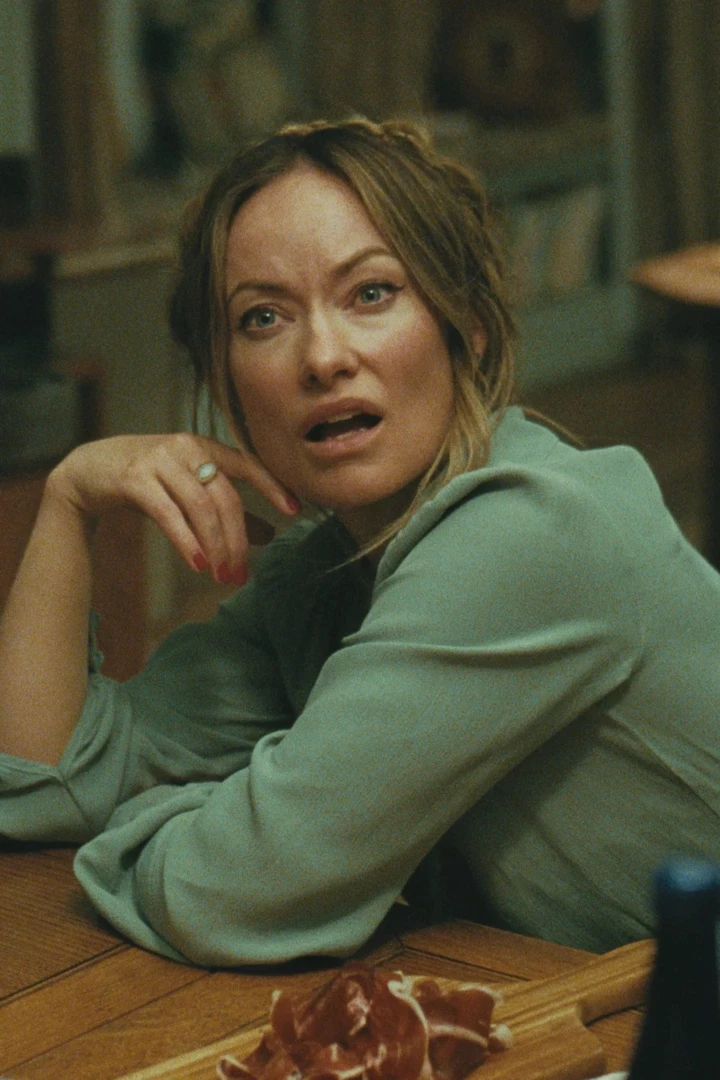
The “death of the romantic comedy” has been discussed more in recent years than the genre itself. Streaming platforms are increasingly filled with monotonous and unfunny films that are hard to distinguish from one another. That’s why it’s especially pleasing to report: this summer, a comedy for adult audiences has appeared on the big screen — witty, brilliantly acted, and surprisingly touching. Olivia Wilde’s “Don’t Worry Darling” (The Invite) is, without exaggeration, one of the season’s major cinematic premieres.
The film is based on a winning formula. It’s an English-language remake of the 2020 Spanish hit “The People Upstairs,” which has already received Italian, French, Swiss, and South Korean adaptations. Rashid Jones and Will McCormack are responsible for the sharp, dynamic dialogue, and the cast is impressive: director Olivia Wilde herself, Seth Rogen, Penélope Cruz, and Edward Norton. It might seem like all this could have failed. A chamber story, unfolding almost entirely in one space, could easily have seemed static given today’s short attention spans. But under Wilde’s direction, the film transforms into a swift, almost continuous emotional journey.
Advertising.
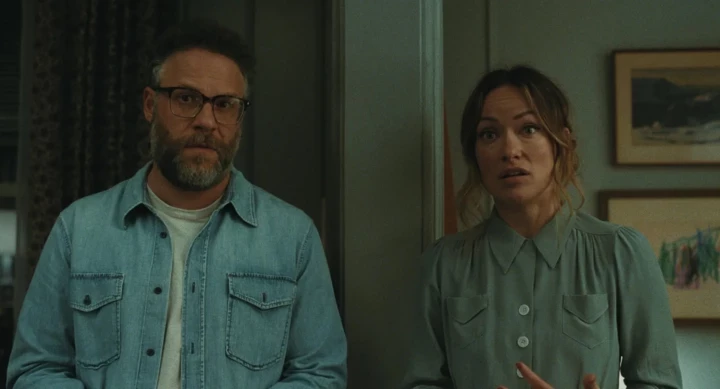
Her confident command of the camera is evident from the very first frames. An abstract prologue hints at the carefree beginnings of a great love, after which the story abruptly transports us to a somewhat comical yet somber present. Joe (Seth Rogen), once the frontman of a promising indie band, now works as a music teacher and leisurely cycles through the hills of San Francisco on his way home to his disappointed wife, Angela (Olivia Wilde). A former artist, she hasn’t engaged in creative work for a long time, instead, with almost maniacal dedication, she endlessly renovates the interior of the spacious apartment the couple inherited. These are perhaps the only scenes where we see the outside world, and they are remarkably dynamic. But as soon as Joe crosses the threshold of his home, the pace only quickens.
Angela and Joe’s twelve-year-old daughter, Maggie, is staying overnight with a friend, so Angela, as it turns out, has invited the upstairs neighbors — Pina (Penélope Cruz) and Gock (Edward Norton) — over for a glass of wine. Joe is outraged. What follows is a biting verbal duel between them, steeped in unspoken mutual resentment — all that seems to inevitably accumulate over years of marriage. It is both incredibly funny and painfully recognizable.
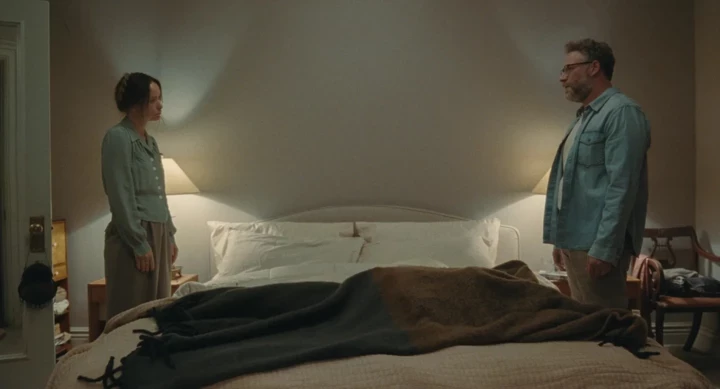
Into this already precarious space enter the charming Pina — a relaxed psychotherapist and sexologist — and Gock, a former firefighter with a laid-back attitude towards life. Relaxed, open in their affections, they are the complete opposite of Angela and Joe: in love, not married, and not at all shy about their passion, which the neighbors often hear through the walls. Angela is nervous and eager to please everyone, hence she is horrified to learn that the cheeses and prosciutto she prepared are not suitable for Pina, who avoids gluten, dairy, meat, and sugar. Joe, meanwhile, can barely hide his irritation and almost snaps when asked to be quieter.
Ahead lies an unbearably awkward tour of the apartment. As the neighbors get to know each other better, new alliances form between them, hidden secrets surface, and unexpected propositions force a re-evaluation of everything that seemed obvious.
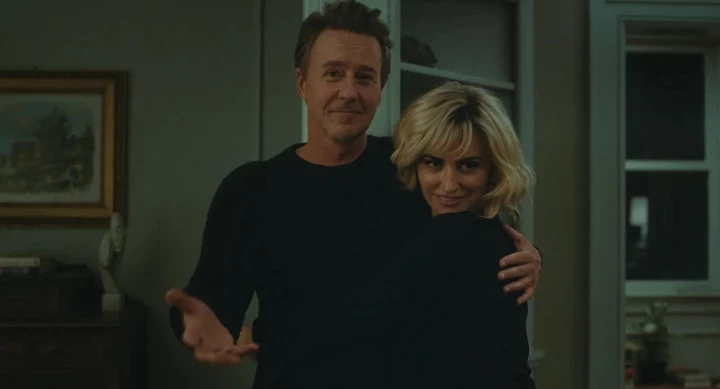
The main star of this work is Olivia Wilde herself. After a challenging experience with “Don’t Worry Darling,” her second directorial film following the triumphant debut “Booksmart,” it’s especially pleasing to see her in brilliant form. The camera confidently glides through the apartment space, revealing new perspectives on human chaos each time. The editing is precise and concise, the rhythm surprisingly light, and the tension steadily builds, eventually reaching an almost unbelievable level.
Despite the strong ensemble, it is Wilde who delivers the best acting performance. With dark circles under her eyes, hastily applied makeup, and constant inner tension, her Angela is like a raw nerve.
In every forced smile, one senses unfulfilled ambitions, creativity put on indefinite hold, and decades of suppressed emotions on the verge of eruption. And at the same time, Wilde is incredibly funny. This is precisely the kind of performance that would make a nomination — and at least a win — at the Golden Globes for “Best Actress in a Musical or Comedy” seem entirely deserved.
Based on materials from Vogue.co.uk