
On the Cannes Film Festival, a new film by French director Arthur Arari was shown. “Unknown” is a slow arthouse film that reinterprets a plot familiar to mainstream cinema about body swapping. Film critic Sonya Vselubskaya explains why this most original film in the competition sparked a heated discussion and how it reveals the acting talent of Léa Seydoux in a new light.
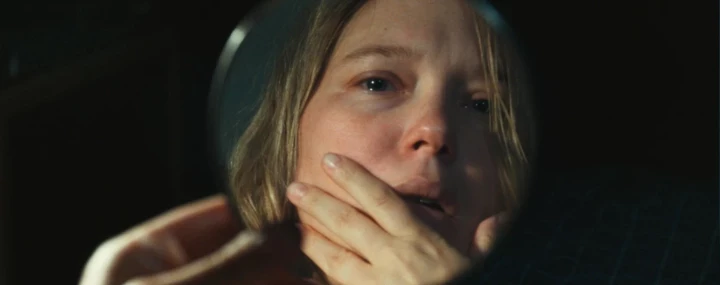
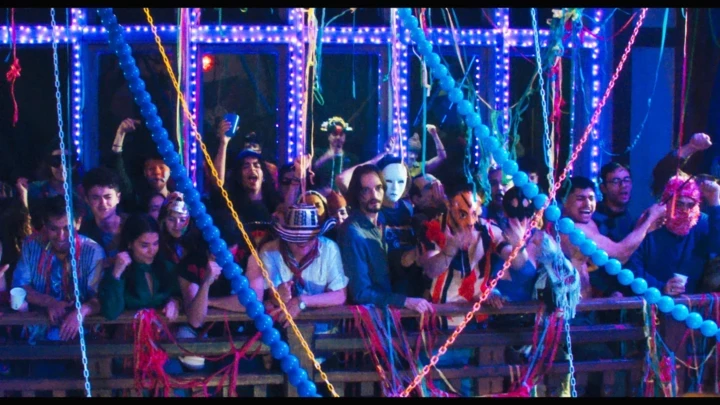
Young David Zimmerman is a talented but unrecognized photographer living alone in Paris. He photographs contemporary cityscapes and compares them with shots from the past taken in the same places; his photographs are as melancholic as he is. One evening, friends drag him to a party to cheer him up, but the bizarre masquerade doesn’t seem fun to the hero at all – rather disturbing and uncomfortable. Until he notices a mysterious girl in the crowd, who, like a ghost, appears in different corners of the dance floor. Charmed, he follows her to the club’s basement, where these two strangers, without a word, merge into a short but passionate sexual act. David disappears, and the camera is left alone with the stranger. Returning home, she falls asleep right on the floor, and in the morning, a real nightmare begins: David finds himself in his apartment, but in the body of that mysterious stranger. After panic attacks and chaotic Google searches, he gets into bed with a mirror. He looks at his beautiful naked female body with surprise and realizes that this transformation seems irreversible.
The history of cinema knows many films about body swapping, which were regularly shown on Ukrainian television at one time. For example, “The Hot Chick” (2002) is a typical example of a fantasy comedy with unpretentious aesthetics, which gave viewers canonical roles of popular actors and largely shaped the image of Hollywood cinema in the early noughties. However, such films are unlikely to offer a serious philosophical reflection on the idea of suddenly finding oneself in the body of another sex. But what happens if a talented European director takes on this concept and turns it into an intelligent and realistic arthouse film? This is exactly what Arthur Arari’s “Unknown” is, which has already secured its status as one of the most original and controversial films of this year’s edition.
Реклама.
Arthur Arari is primarily known in Cannes as a co-writer of Justine Triet’s “Anatomy of a Fall,” which won the Palme d’Or in 2023. From the very first minutes of “Unknown,” it is evident that the film comes from the heart of a gifted screenwriter and admirer of Italian classics. Arari directs this story at a slow pace, with undisguised references to Michelangelo Antonioni’s films, especially “Blow-Up” – a masterpiece of psychological thriller about a photographer. On the script level, the story is presented through eloquent, concise dialogues and minimalism of action within the mise-en-scènes. Together, this gives “Unknown” the status of a sophisticated psychological horror, because what does one do when they wake up in someone else’s body in this lonely metropolis? How do you get used to it? Where is your home now, and how do you cope with the longing for parents who will clearly never believe that it’s really you? David, in the body of Léa Seydoux’s character, sets out in search of the owner of this body in the hope of finding himself in her. Meeting face-to-face with his frightened face in the rain in the middle of the street, he realizes that there is another girl inside his body. It becomes clear that this chain of sudden body swaps is so convoluted, large-scale, and seemingly irreversible that both of them can only cling to each other, getting used to a new physiology that they don’t want to accept at all.
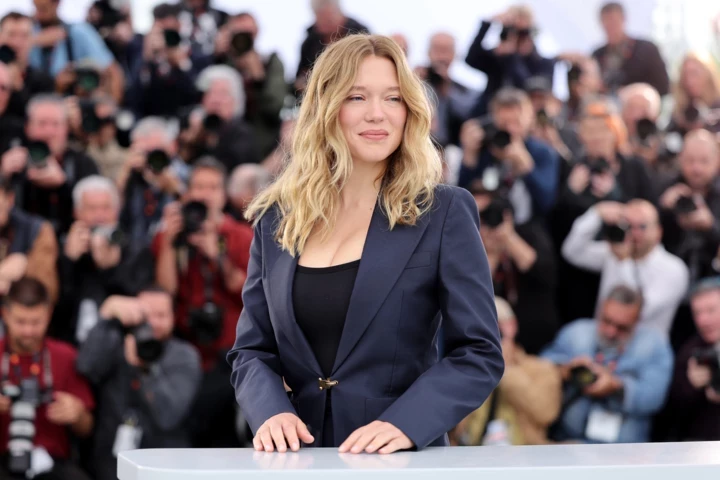
This is the second time we are seeing Léa Seydoux in the main competition this year. In addition to Arari’s film, the actress also impressed with her leading role in Marie Kreutzer’s “The Phantom Thread,” where she also works with complex material. In this film, she plays a musician and mother in a young family who suddenly faces accusations against her beloved husband, who for years secretly stored and distributed pornographic content involving minors. Looking at this heartbreaking drama, built on an ocean of tears and exhaustion from emotional pain, as well as her role in Arari’s film, which is no less dependent on close-ups of her frightened face, it’s hard not to reflect on the actress’s career retrospectively. Today, she is known as one of the most sought-after actresses of our time, but the beginning of her career was not easy. Her breakthrough is considered to be her role in “Blue Is the Warmest Colour” – a lesbian drama with extremely explicit intimate scenes, which was remembered not only for its success but also for the dirty scandals surrounding its unethical production. This experience left a deep psychological mark on both Seydoux and Adèle Exarchopoulos, who played the main role there. It is even more impressive that both actresses did not break under the pressure of this experience and managed to move away from purely sexualized images, earning the trust of talented directors primarily due to their dramatic talent.
“I allowed myself to go as far as I never had before. I can say that in my 20 years of acting career, for the first time I felt complete, found myself in the right place. For the first time, I realized – I don’t want to sound pretentious – that I have talent,” Léa Seydoux commented before the world premiere of the film. For an actress of such caliber, such words sounded encouraging, and yet, even against the backdrop of her prolific career, Seydoux delivered one of her strongest performances. She portrays a confused and frightened man with exceptional fragility, conveying through body language physical discomfort bordering on curiosity, as well as sadness, despair, and that primal existential fear of irreversibility and the unknown, which is reflected in the film’s title.
Currently, Arari’s film is facing a barrage of criticism on the Croisette, with a significant portion directed at the alleged dismissive representation of transgender experiences. Although a queer drama reading lies on the surface of the film, at the same time, it is so abstract and elegant in its motifs that its conscious departure from established queer cinema norms only adds depth, in which it also resembles the film “Teenage Sluts and Death Camp.” Moreover, in the main competition, the vast majority of films are cautious with trivial genre patterns, reviving outdated narratives under the guise of sophisticated visual form. This is especially true for films like James Gray’s “Paper Tiger” or László Nemes’ “Moulin.” Therefore, against this backdrop, “Unknown,” which combines a beautiful audiovisual form with a truly unusual, complex plot and also reveals Léa Seydoux’s talent in a new way, feels like a breath of fresh air.