

Amidst a sea of exceedingly gloomy and joyless cinema (“Pawel Pawlikowski’s ‘Cold War’,” Asghar Farhadi’s “A Separation,” and James Gray’s “The Lost City of Z”) at Cannes, a bright spot emerged—Jordan Firstman’s vibrant directorial debut, “Rotting in the Sun.” The film also marks the return to the big screen of the talented actress and model Cara Delevingne.
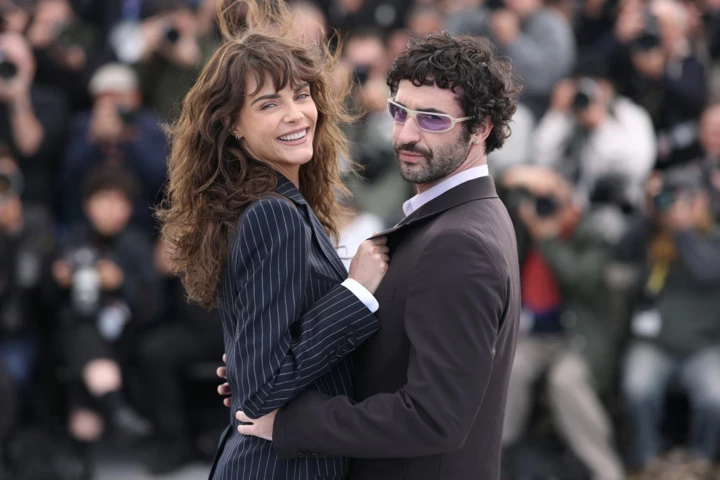
Perhaps you know Firstman from his viral Instagram sketches, or you recall his light, charismatic acting in the film “I Love Los Angeles.” In “Rotting in the Sun,” Firstman showcases himself as a multi-talented individual, serving as director, screenwriter, and lead actor. At first glance, the film appears safe and light, but it ultimately reveals itself to be significantly deeper. It subtly sneaks up on the viewer with an unexpected emotional weight that truly throws one off balance. And at the same time, it’s an incredibly compelling story.
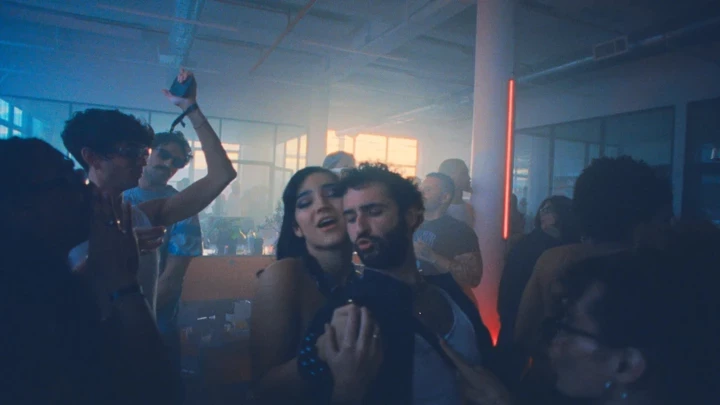
It all begins in the bustling, pre-pandemic New York City of 2016. Rihanna’s “Sex with Me” blasts in an Uber, and professional party animal Peter (Firstman), his best friend and business partner Sophie (a welcome return to the screen for Cara Delevingne), and their entire entourage are en route to one of their monthly no-holds-barred club parties. Money flows freely, but so does their indulgence—drugs, questionable decisions, and fragmented memories of nights no one fully recalls.
We then jump forward about ten years—and it seems almost nothing has changed. Peter is still throwing parties, waking up mid-day, starting his mornings with lines of cocaine, endlessly lounging in bed, watching anime porn, meeting men on apps, and arriving at crucial work meetings in a completely inappropriate state. Sophie, fed up with it all, threatens to cut him out of the business, but Peter desperately tries to prove he’s capable of responsibility. And that’s precisely when he’s handed the biggest responsibility of his life: a former patron of his club nights appears at his doorstep with ten-year-old Arlo (Rege-Jean Page), who has just flown in from London, and declares—get this—that he’s his son.
Advertisement.
It seems the boy is the result of a long-forgotten sexual encounter with some wild Brit—though Peter himself is almost convinced he’s never slept with women. Following Arlo’s mother’s sudden death, he is now under Peter’s care. The deceased’s friend states she always wanted her son to have a connection with his biological father. Peter attempts to get rid of the child, but when that fails, this charming and somewhat quirky buddy comedy truly takes off.
Peter, who has spent his life frantically avoiding any responsibility, now tries to enroll Arlo in school and arrange medical insurance for him; tidies up his own life a bit; and Arlo himself integrates surprisingly organically into the world of endless nighttime raves. The musically gifted teenager even gets behind the DJ booth with his newfound father.
But reality inevitably intrudes, and the fairy tale begins to unravel. Can Peter and Arlo remain together? And perhaps more importantly—should they? What will truly be best for Arlo?

Firstman masterfully balances raucous comedy with genuine poignancy. Yes, there’s one overly sentimental, drawn-out speech and a somewhat simplistic exploration of trauma, but these are minor flaws rather than the film’s essence. Its heart lies in explosively funny scenes and lines that leave you chuckling quietly hours later, even while watching other films in Cannes.
The New York depicted by the director feels alive and textured; the direction is confident; Cristóbal Tapia de Veer’s score is pulsating; and the parties are sticky, chaotic, and dangerously beautiful, as if suspended on the brink between pleasure and self-destruction. The excellent ensemble of regular partygoers adds credibility and life to Firstman’s world. (Though Diego Calva, as Peter’s romantic interest, clearly deserved more.) Add to this Firstman’s natural charisma and his surprisingly subtle connection with Arlo, played by Page—and it becomes a film you want to linger in until morning, sprawled on the floor like you’re at a friend’s apartment after another party.
Peter himself slips into the father role with an ease as if he was born for it. Can a person change so quickly? Is it truly that simple? Beneath all of Firstman’s bravado, there’s a palpable fear of portraying Peter as less appealing—as someone who can make serious mistakes, cause pain, or even conflict with Arlo. And yet, despite all the caveats, “Rotting in the Sun” ultimately hits the mark—with a subtle, almost imperceptible scene that sends shivers down your spine and brings a lump to your throat. Like its protagonist, this film is funny, warm, absurd, wildly entertaining, occasionally irritating, and prone to slipping into clichés, but it’s almost impossible not to fall in love with it. If only all films on the Croisette were this much fun.