

The Cannes Film Festival’s “Un Certain Regard” section premiered the new film by transgender director Jane Schoenbrun. Film critic Sonya Vselubskaya talks about “I Saw the TV Glow,” where characters played by Hannah Einbinder and Julianne Moore re-examine horror, female sexuality, and the very nature of desire.
Advertisement.
Amidst the 1980s pop culture explosion, cinema birthed a golden era of horror films. Widespread video rental, cheap video cameras, and loosened moral standards gave rise to cult classics like “A Nightmare on Elm Street” and “The Texas Chain Saw Massacre” franchise. The horror element itself, sometimes unconvincing due to limited production scope, often coexisted with hyper-sexualized narratives frequently revolving around teenage relationships. Audiences of these films, especially those who identified with the characters’ age, discovered sex and the world of genre cinema simultaneously. They grasped the strange sensation of fear and excitement coexisting and tried to comprehend deeper meanings within these subtexts, meanings that seemed far greater than themselves at the time. Perhaps they pointed to a certain strangeness, or in a word, queerness.
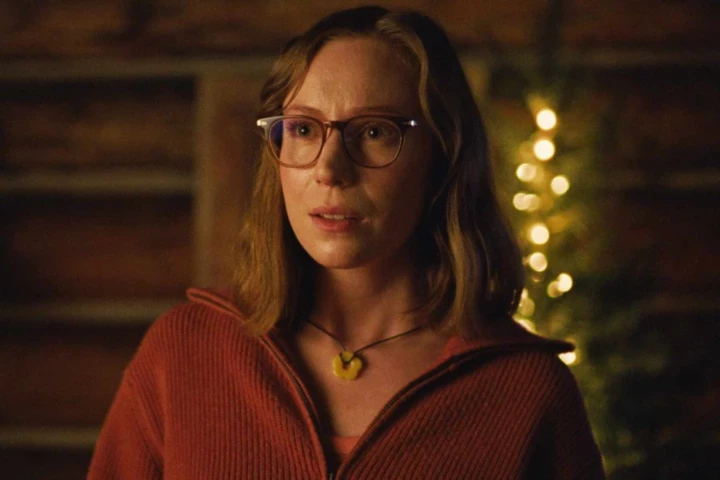
These are precisely the feelings experienced by the main character in “I Saw the TV Glow” – 29-year-old Cris (the wonderful Hannah Einbinder). She is an ambitious and principled queer filmmaker who suddenly receives a professional offer she could only dream of. “Miasma Camp” was once a popular slasher franchise, consisting of a series of low-budget, lurid films about Mr. Little Death, who lived in a river and hunted in a camp where 17-year-old teens lost their virginity.
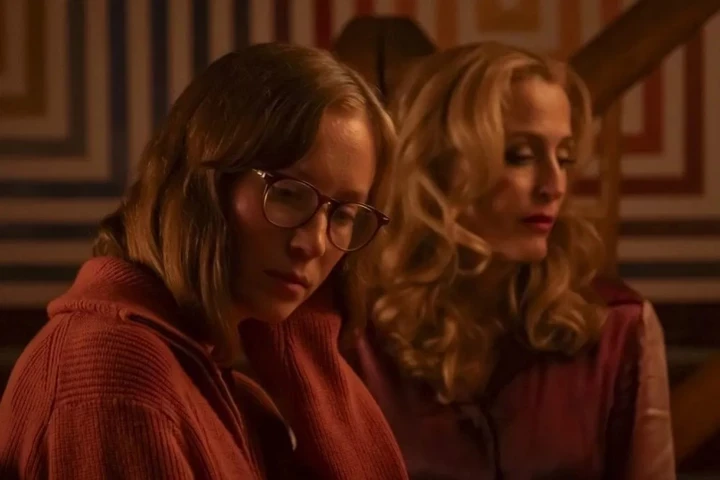
Cris, as a devoted fan of the show, gets an incredible chance to revive the franchise with her own modernized vision. However, a sequel is impossible without a “final girl” – a former heartbreaker who, however, left acting and now lives in complete seclusion at the same Miasma Camp. It is there that Cris heads at the beginning of the film, seeking a creative connection. Traveling to the camp through snowy roads, where she is greeted by cozy wooden houses, a dark forest, and a cinema hall with a film projector. The inspired protagonist explores the surroundings until, right in that cinema hall, as if emerging from the projector, the legendary Billie Pressley (the captivating Julianne Moore) appears. A glamorous blonde with voluminous curls and alluring attire, she mysteriously invites Cris to dinner at her home. Realizing the highly cinematic vibe of their meeting, she jokes that she probably resembles Gloria Swanson from “Sunset Boulevard,” and this is indeed a very apt parallel.
However, Cris’s film ideas encounter Billie’s irony, as she is not ready to open up so easily and return to the screen. First, it is important for the actress to give her guest a chance to understand what this franchise truly means to her, and Billie, with the wisdom of her age, is ready to offer many revelations. Thus, through evening gatherings by the fireplace, watching the franchise’s films, and ultimately, frank conversations about each woman’s sexuality, they build a spiritual and romantic connection. “I Saw the TV Glow,” which began as a playful lesbian drama, gradually acquires additional layers of fantasy and reflection, adopting the cinematic language of the original franchise. The film employs acid colors and absurd editing decisions that confidently blur the line between reality and cinema, wandering between horror and excitement until everything takes the form of an explosive sexual fantasy.
Jane Schoenbrun is likely the most renowned transgender director of our time and one of the most talented indie filmmakers of her generation overall. Growing up as a queer teenager at the end of the 20th century, she sought answers to questions about her identity in films, books, and internet forums. Her films, so sharp-witted, dreamlike, and exceptionally cinephilic, are dedicated to reinterpreting popular culture and gender norms. Such, for example, was her previous hit “I Saw the TV Glow” – a slow-burn arthouse film that became a unique reflection on transgender identity.
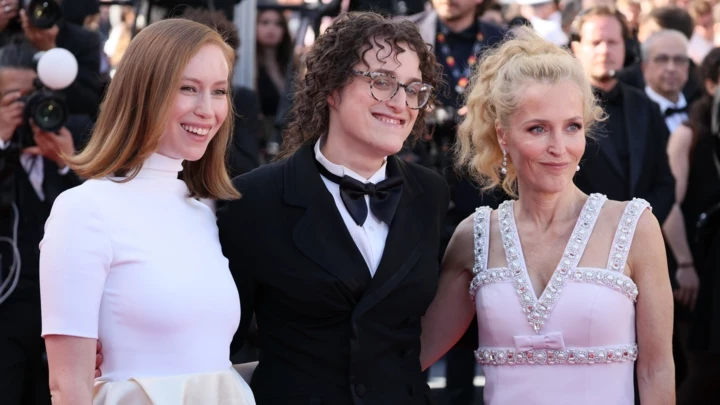
In “I Saw the TV Glow,” having already gained the trust of studios and expanded beyond a purely queer audience, Schoenbrun conquers Cannes with a wild psychosexual carnival that delves into complex issues of identity, female pleasure, and the great legacy of horror. By addressing the genre, she brings to the surface the historical role of women in it – both those who played these roles and those who were shaped by these images. Ultimately, the film poses a rhetorical question: why does horror resonate so strongly with girls who grew up a little differently than everyone else? Why, today, watching these films with their frankly scandalous and unethical moments, do we remain captivated by them? And how are these bizarre on-screen images connected to female sexuality or even to a reluctance for sex altogether?
There is a moment in the original franchise that stuck in Cris’s memory and returns in Schoenbrun’s film again and again: Billie’s character, having sex without any pleasure, achieves orgasm precisely at the moment Little Death inserts his weapon into her. By rewatching and discussing these scenes over and over, the film hints that sometimes the real horror in such films comes not from the paranormal, but from real, intrusive sexual discomfort.
“I Saw the TV Glow” is replete with intertextual references to cinema, TV shows, and internet jokes, generous with symbols and metaphors, as well as mockery of modern woke culture. However, this oversaturation does not repel, but rather, it connects us more strongly to the story, offering numerous points of connection for the most diverse cultures and their VHS or DVD canons. Among all these subtexts and metaphors, the diamond of the film is the inimitable Julianne Moore, who once again impresses with her script intuition and courage to take on such explicit roles. It is hard to imagine a more suitable actress for this role, and for Schoenbrun herself, a huge fan of “The X-Files,” working with Moore was her wildest dream.
Moore delivers a magnetic performance, bringing to the film that necessary intoxicating aura of her screen influence spanning several pop culture epochs. It is from those films and series where young girls like Cris sought solace by gazing at the screen. And, as Schoenbrun shows, sometimes sexual fantasies can indeed enter reality, one just needs to trust the game and discard outdated stereotypes. For Moore herself, as she admitted in an interview with Variety, this film is an open dialogue “with anyone who experiences dissociation, has an out-of-body experience, or feels they are not part of accepted social norms and don’t fit within their framework… this film is perfect fodder for escapism.”